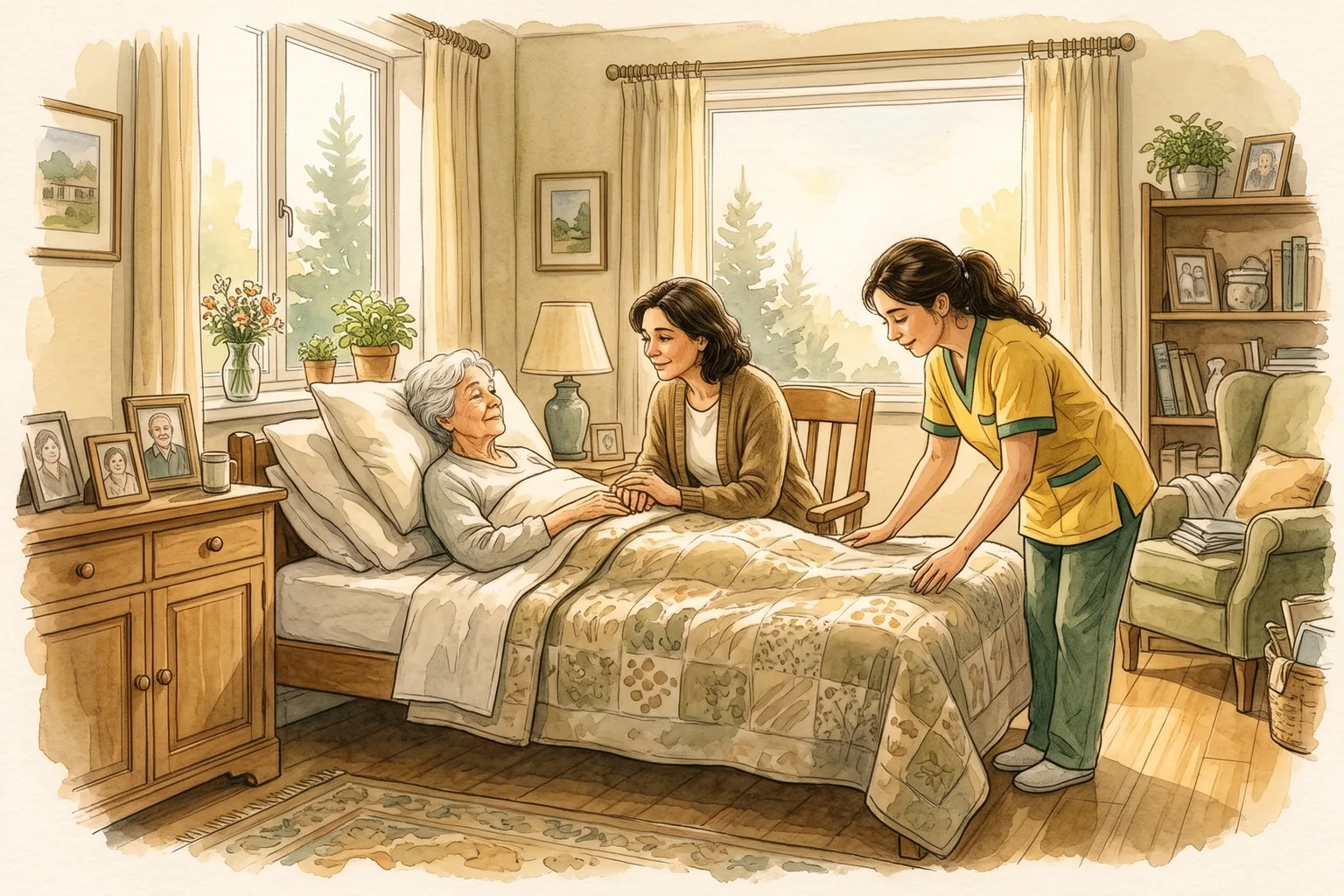
Palliative home care in Calgary usually comes in two parts. Assisted Living Alberta Palliative Home Care provides the publicly funded side, and a private home care provider like Alberta Maple Care can add personal care, overnight help and breaks for the family around it. We work alongside your palliative team, not in place of it, and we help you sort out which hours are funded and which are private.
What palliative care at home means
Palliative care is care for someone living with a progressive, life-limiting illness. The aim is comfort and quality of life, not cure; that is how MyHealth Alberta describes the goals of hospice palliative care. At home, it means the person can stay in their own surroundings for as long as possible, with help coming to them.
Many families find us by searching for end of life care at home, and that’s the same thing. It covers the family as well as the person who is ill, including grief support while you’re caring for them and afterwards. Our end-of-life and palliative care page sets out what we provide.
Who arranges what
Most families who come to us already have the Assisted Living Alberta palliative team in place, and most reach us through their doctor. That team belongs to Assisted Living Alberta Palliative Home Care, the publicly funded program. Its supports include in-home clinical care, access to consult teams, hospice, crisis response at home, and grief and bereavement resources. Assisted Living Alberta took over the home care role that Alberta Health Services used to hold, so you may still hear the old name.
We sit beside that team. We coordinate with your zone team and fill the private gaps when they’re needed: more hours of personal care, someone in the house overnight, a few hours off for the person doing most of the caring. The short answer on staying at home with palliative supports is in our FAQ.
When symptoms change, the palliative nurse or physician decides what happens next, through your zone’s on-call pathways. Your palliative team gives you its own after-hours contact details, so keep them somewhere everyone in the house can find them. Alberta also has an EMS Palliative & End-of-Life Care “Assess, Treat & Refer” program, run through Alberta Health Services, that helps manage a crisis at home when it’s safe to do so. Your palliative team can tell you how to reach it in your zone.
If nobody has assessed your family member yet, call the Continuing Care Access number for your zone and ask for an assessment. You don’t have to wait for it before getting help. Private care with us can start while the public side is still being worked out. How the Assisted Living Alberta assessment connects to funding is on our CDHCI page.
What our caregivers help with at home
Most of what we do is the hands-on care that keeps someone comfortable through the day: gentle bathing, mouth and skin care, repositioning, help with the toilet, incontinence care, and the turning and checks that help prevent pressure injuries. These are the tasks that usually sit alongside what the public palliative team provides.
Our caregivers also watch for changes. Pain, breathlessness, agitation or confusion, nausea, constipation: they note what they see and pass it to the palliative nurse or physician using the pathway your team has set up. Deciding what to do about a symptom stays with the palliative team.
Equipment tends to be one of the first practical jobs. We help arrange hospital beds, walkers, commodes and other items through public programs where you’re eligible, then set them up and show the family how to use them safely.
A Registered Nurse reviews the care plan before care begins. Your family member has one main caregiver and one backup they already know, so the person coming through the door is someone familiar. Every caregiver is background-checked before working with clients. If you want to see exactly which tasks are part of a visit, the full list is on what your caregiver does.
Nights, and rest for the family
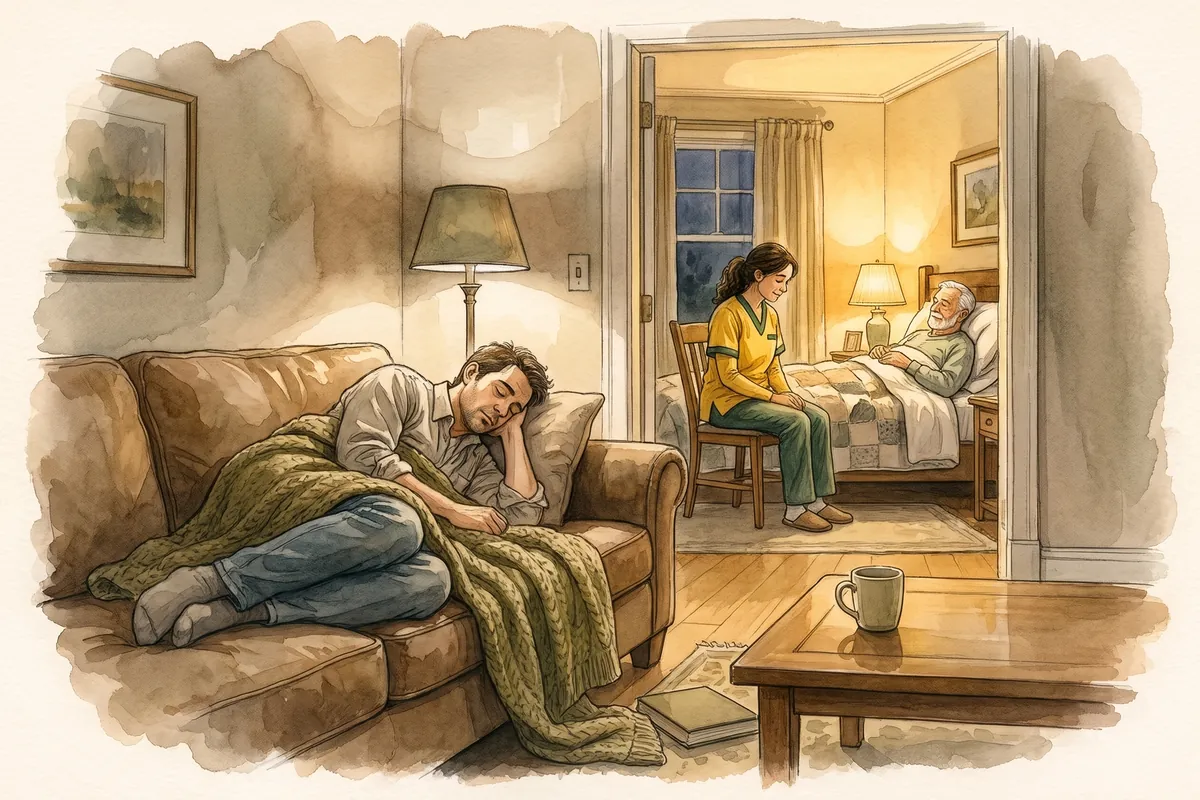
Nights are often where families run out of strength first. An overnight caregiver can be awake all night or resting on site, depending on what your family member needs. How long a night runs depends on those needs and on caregiver availability, and we work that out with you. Overnight care is billed at its own rate, $39.00 per hour. There is more on how it works in overnight care for seniors.
If someone needs to be there around the clock, we staff it as rotating 8 to 12 hour shifts or as a live-in caregiver with set rest periods, with overnight checks and turning built into the routine. See 24/7 and live-in care.
Respite is a planned break for whoever is doing most of the caring. In-home respite can be a few hours a week or a rotation over several days, with caregivers matched to your family’s routine, language and culture. Our caregivers can also coach you on comfort measures and on what to expect. A respite bed in a facility is different: it is booked through a Home Care case manager, not through us. In-home respite or a respite bed compares the two, and our respite care page lists what a respite visit includes.
Paying for it
The wider palliative services are arranged through Assisted Living Alberta Palliative Home Care. Alongside that, after an Assisted Living Alberta assessment, personal care, in-home respite and health-linked homemaking may be authorized under Client Directed Home Care Invoicing (CDHCI). Homemaking can’t be approved on its own; it has to be linked to personal care or health needs. CDHCI usually asks for care needs that are predictable month to month, but exceptions can be made for palliative clients. Our FAQ on how CDHCI fits with palliative care has the detail.
Alberta Maple Care is a registered CDHCI provider, and we bill Alberta Blue Cross directly for approved hours. Alberta Blue Cross pays $35.03 of each approved hour and you pay the balance. At our rates that balance is $2.47 per approved daytime hour and $3.97 per approved overnight hour. Approved hours are subsidized, but they are not free, and the number of hours is decided only by your case manager.
Hours beyond the approval are private care, at $37.50 per hour by day and $39.00 per hour overnight. Some families also look at insurance benefits, tax credits or Veterans programs, and ways to pay for home care in Alberta goes through each one. Current rates and an estimator are on our pricing page.
Support for the family, during and after
Grief and bereavement resources are part of the public palliative program. Alberta Health Services and MyHealth Alberta list grief programs, including zone brochures, support groups and MyGrief.ca, and Health Link 811 or 211 can point you to what’s near you. The same list is in our FAQ on grief and bereavement support.
Talking to us
The first in-home assessment visit is free and no-obligation, and we reply to every enquiry within one business day. That visit is our own planning visit, separate from the Assisted Living Alberta assessment. We set the schedule together with you. Standard visits are 3 hours, and shorter visits can be arranged. You can book the visit online or use the form below.
If you’re a doctor, discharge planner or case manager, you can send us a referral through refer a patient.