AADL in Calgary is the program many families meet the week a walker, a bath seat or a home care bed stops being optional. Alberta Aids to Daily Living funds basic medical equipment and supplies so people with a long-term disability, chronic illness or terminal illness can keep living at home. The rules are published, the steps are fixed, and the order matters: get the equipment the wrong way round and the program will not pay for it. Here is the path, from the official Alberta.ca pages, with the figures as they stood when we read them.
What AADL funds
The program’s benefit list is long; the categories that matter most for living at home are these.
- Mobility and positioning: manual and power wheelchairs, walkers and walking aids, wheelchair cushions and accessories, transfer aids, patient lifters, home care beds and accessories, pressure-reduction overlays, specialized seating.
- Bathroom and personal care: bathing and toileting equipment, incontinence supplies, ostomy supplies.
- Breathing and medical supplies: oxygen, respiratory equipment and supplies, compression garments.
- Footwear and prosthetics: custom-made footwear, therapeutic shoes with custom modifications, prosthetic devices, breast prostheses.
- Hearing, vision and communication: hearing aids, vision aids (through the CNIB) and speech-generating devices.
Some larger items, such as wheelchairs, lifters and home care beds, may be recycled rather than new. Home care beds have their own rule: the person must spend most of their time in bed or be in end-stage palliative care, and beds are not provided to people in acute care or continuing care centres.
Who is eligible
- An Alberta resident with a valid Alberta Health Care Insurance Plan card.
- Needing help because of a long-term disability, chronic illness or terminal illness; “long-term” and “chronic” mean six months or longer.
- Assessed by a health professional. There is no income test for eligibility itself; income only affects cost-sharing, below.
You may not be eligible if comparable benefits are available elsewhere: Veterans Affairs Canada for a condition arising from service, the Workers’ Compensation Board, Non-Insured Health Benefits for people with treaty status (if NIHB does not cover an item and you otherwise qualify, AADL can), or a private insurance plan. Newcomers who have not yet lived in Alberta for twelve consecutive months are also outside the program.
The steps, in the order that works
- Get assessed by an AADL authorizer. Authorizers are health professionals approved by the program, and they are the only route in. For most equipment, contact your local hospital or health centre and ask for an assessment by an approved AADL authorizer, or call Health Link at 811. If you already have a home care case manager, ask them; home care teams work with authorizers every week. For oxygen, orthotics, prosthetics and hearing aids, the assessment is done by a professional at an approved specialty vendor.
- Do not buy first. The program does not reimburse equipment bought before it was assessed and authorized. A walker from the pharmacy on Tuesday is a walker you paid for in full.
- Choose an approved vendor. The authorizer gives you a list of at least three approved vendors, or you choose from the program’s vendor list. Large equipment such as wheelchairs and beds is bought by the program and delivered to your home.
- Pay your share, if any. Most benefits are cost-shared (next section). Respiratory benefits are not, and seniors pay no cost-share on prosthetics, orthotic braces, breast prostheses or ocular prostheses.
Cost-sharing and exemptions
The figures below are quoted from Alberta.ca as read on 18 October 2026; the program sets them and can change them, so confirm on the live page before counting on a number.
- Clients pay 25% of the cost of most benefits, up to a maximum of $500 per family per benefit year (1 July to 30 June).
- If you choose an upgraded item, the extra cost is yours and does not count toward the $500 cap.
- Cost-sharing is waived for lower-income households, based on taxable income (line 26000 of the most recent return): $20,970 or less for a single person, $33,240 or less for a family with no children, $39,250 or less for a family with children.
- People receiving Income Support, AISH or certain other provincial benefits may contact AADL directly about an exemption.
What this looks like in a Calgary home
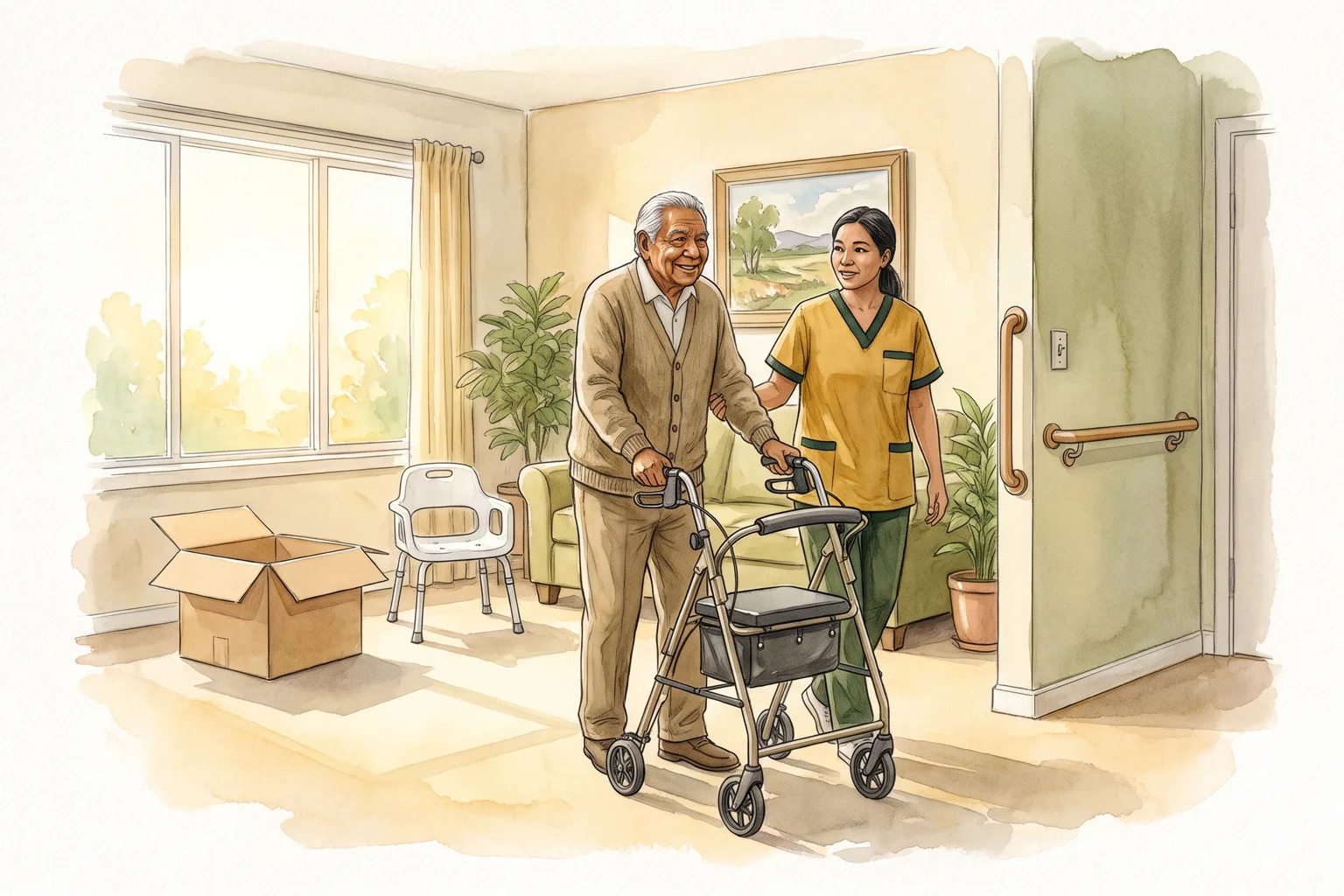
A typical sequence after a fall, a new diagnosis or a hospital discharge: the occupational therapist or home care team identifies the need; the authorizer assesses and authorizes the specific item; the vendor delivers or fits it; and somebody at home makes the house ready for it. That last step is the one that gets skipped. A home care bed that arrives into a room nobody cleared, a walker that cannot turn in a hallway, a bath seat with no grab bar beside it: the equipment is funded and the home still does not work.
That is where our home organization, safety and equipment service fits. We are not an AADL authorizer and not a vendor; we do not assess for the program or sell equipment. What we do is the part around it: a room-by-room safety reset, clear pathways and better lighting, a recovery zone on one level, coordination with your authorizer and vendor so the delivery date and the house line up, and the small setup work once the equipment arrives. Where a case manager has approved home care hours under CDHCI, some of that work can run alongside funded personal care; the rest is private, at our published rate.
Before you call anyone
- Have the Alberta Health Care number to hand.
- Write down what the person can no longer do safely and where in the house it happens; authorizers assess need, not wishes.
- Check for other coverage first (a veteran’s benefits, a workplace injury claim, a private plan), because it changes who pays.
- Keep the receipt and the authorization together; your cost-share counts toward the yearly cap across the family.
Next step
If you are not sure whether the problem is equipment, help at home, or both, a free visit answers it: a nurse looks at the person and the house together and tells you what to ask the authorizer for and what we can do in the meantime. No cost, no obligation, and we reply to every enquiry within one business day. Book a free visit or call .
Sources
- Government of Alberta, Alberta Aids to Daily Living (read 18 October 2026): the program and its authorizers and vendors.
- Government of Alberta, AADL benefits covered (read 18 October 2026): the benefit categories and the home care bed rule.
- Government of Alberta, AADL eligibility and application for benefits (read 18 October 2026): eligibility, the assessment, vendors, other coverage.
- Government of Alberta, AADL cost-sharing of benefits (read 18 October 2026): the 25% share, the yearly maximum, upgrades and the exemption thresholds.
This article is general information. Eligibility, benefits and cost-sharing are decided by the program; the Alberta.ca pages above are the authority, and the figures on them can change.