
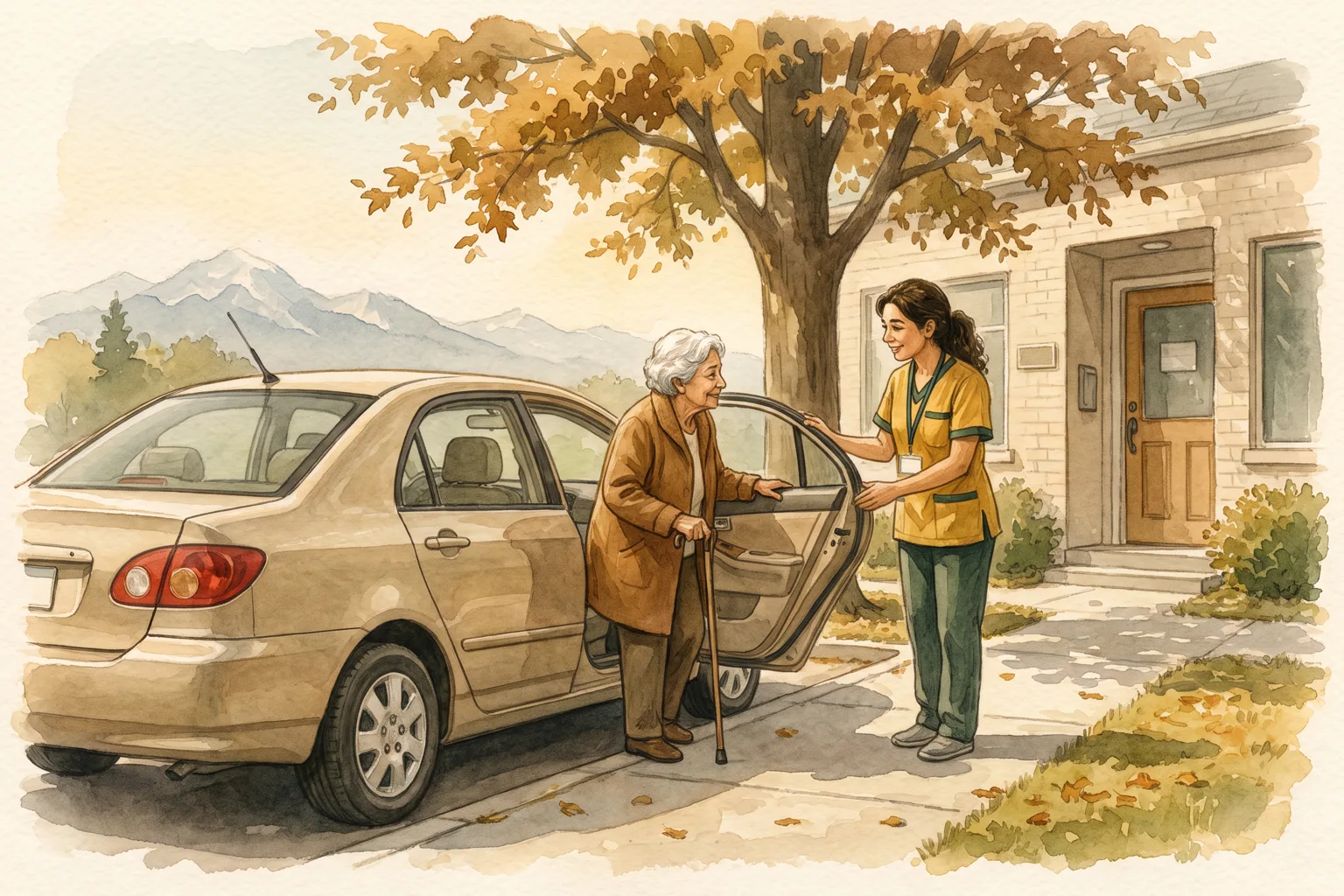
Senior transportation in Calgary is a bigger problem than it looks from the driver’s seat. The specialist is across the city, the appointment is at 9:40, the parking lot is a long walk from the door, and the person who used to drive is the person with the appointment. Families solve it with a patchwork: a daughter’s vacation day, a neighbour, a taxi, a bus pass nobody has used in years. This article lays out the real options, public ones first, with the rules as they stood when we read them, and then says plainly when a caregiver who drives, waits and takes notes is the better fit.
Calgary Transit Access
Calgary Transit Access is the City’s shared-ride, door-to-door public transportation service for Calgarians who are unable to use regular buses and CTrains. It is the first option to check, and the one most often misunderstood.
- Eligibility is about disability, not age. The question is whether a disability prevents the person from using Calgary Transit’s buses and CTrains. Age, income, language barriers, fear of or unfamiliarity with transit, and the length of the trip are not considered, and a recommendation from a medical professional on its own does not qualify someone.
- Applying takes a form and an interview. The applicant completes parts A to F of the application; a medical professional completes part G. It is submitted by email, fax or mail. The eligibility team then calls, typically within 5 to 10 business days, to schedule an in-person interview with functional assessments, and the decision follows within 5 business days of the interview. Transportation to the interview is not provided. A paper form can be requested on 403-537-7770.
- Booking is the day before. Casual trips must be booked no later than 5 p.m. the day before and can be reserved up to four days ahead; regular trips can be set to repeat. Book online through the CTA Trip Booking tool or by phone on 403-537-7777, option 2, between 9 a.m. and 5 p.m. daily, except statutory holidays.
- It is shared and scheduled. Because rides are shared, plan for a longer trip than a direct drive and build in time at both ends. Fares and the passes accepted are on the service’s own fare pages; check them before the first trip.
For a person who qualifies and whose appointments are predictable, this is the backbone. What it does not do is come inside, sit through the appointment, or carry the instructions home.
Wheelchair-accessible taxis
For someone who uses a wheelchair or a mobility scooter, whether long term or for a few weeks after surgery, the City runs a central dispatch for wheelchair-accessible taxis, Wheelchair Accessible Vehicle Calgary. Call 403-974-1110 or book through its website or app; the nearest available accessible taxi is dispatched and you are given an estimated wait. There is no pre-registration, and the fare is the taxi’s metered rate. One caution on dates: the City’s page still describes the service as a two-year pilot that ran to December 2021, with the intention of making it permanent. The page and the number were live when we read them on 18 October 2026; if you are counting on it for a specific appointment, confirm with 311 first.
Regular taxi companies also run accessible vans of their own, and ordinary taxis and ride-hailing work for anyone who can transfer into a car seat and manage the walk at each end. None of them waits through the appointment or remembers what the doctor said.
Volunteer driver programs
Calgary has volunteer driver programs built for exactly this trip. One of them is the Essential Transportation program at Calgary Seniors’ Resource Society, where volunteers give seniors door-to-door rides to medical appointments, with a different volunteer signing up for each ride through the society’s online system. Its office line is 403-266-6200, Monday to Friday, 8:30 a.m. to 4:30 p.m. Programs like this run on volunteers, so ask early, ask how much notice they need, and ask about their rules on escorts, walkers and wheelchairs.
For the current list of volunteer and non-profit transportation programs serving your part of the city, call or text 211, Alberta’s free, confidential community services line, answered live around the clock, or search its database at ab.211.ca. Listings change; 211 is where the current ones live.
If the appointment is out of town, Alberta’s Special Needs Assistance for Seniors program can help eligible lower-income seniors with the cost of medical trips of more than 80 km round trip to see a specialist or for testing or treatment. It needs a report from the specialist or facility confirming the appointment dates and that the person attended, which rules out most trips within the city but matters for anyone sent to a clinic in Edmonton or Lethbridge.
Family and friends
Many rides still come from family, and that works until it does not: the vacation days run out, the appointment moves, or the person doing the driving is the one who should not be. The hidden cost is rarely the fuel. It is the waiting. A specialist appointment with imaging, bloodwork and a pharmacy stop on the way home is half a day, and the person giving up that half-day is usually also the one managing everything else. When it starts to fray, the question is not “who can drive” but “who can be there for the whole thing”.
When a caregiver who drives, waits and takes notes makes sense
Alberta Maple Care’s caregivers help clients get to appointments: a caregiver can drive the client to and from the appointment, go with them door through door, and wait with them. It is booked separately from regular visits, with travel time and mileage charged separately. The visit covers the whole trip, not just the drive: the appointment details, building access and parking confirmed in advance; a safe transfer in and out of the car; the walk from the parking lot to the right desk; the wait; with the client’s consent, a seat in the room and plain-language notes on next steps and medication changes; a brief summary to the family afterwards; and a check that the walker, glasses, hearing aids, health card and medication list made the trip in both directions. It is described in full on our Transportation & Escort page.
It tends to be the right fit when:
- the instructions matter, such as a new diagnosis, a medication change or a consent conversation, and nobody in the family can be in the room;
- mobility or memory changes make the walk from the car, the waiting room and the way home the risky part, not the drive;
- the appointment is one of several in a week, as it often is after a hospital stay or around a new treatment;
- the family lives out of town and wants someone they know at the appointment and a clear account afterwards;
- the public option is not available on the day: an application to Calgary Transit Access still in progress, a volunteer program without a driver that week, or a time the shared ride cannot meet.
The money, plainly. The visit is billed by the hour at our published daytime rate of $37.50 per hour within Calgary city limits, booked separately from regular visits as a visit of at least 3 hours, with travel time and mileage at $0.75 per kilometre charged separately and itemized on the invoice. The hourly rates are on our pricing page. On funding: CDHCI pays for approved hours of personal care, respite and health-related homemaking, and a ride on its own is not one of those services, so families pay for it privately. It sits beside funded care in the same week without affecting it. Ask your case manager about your own plan, and see our CDHCI guide for how the program works; Alberta Maple Care is a registered CDHCI provider.
Errands are the sister service. If the trip is to the pharmacy, the bank or the grocery store rather than a clinic, our Errands, Shopping & Groceries service covers it, with the client or for them.
Before the appointment, whoever drives
- Health card, photo ID and the current medication list, including anything bought over the counter.
- The three questions the family most wants answered, written down, with space for the answers.
- Glasses, hearing aids and the mobility aid the person actually uses, not the one in the closet.
- Which entrance, which floor, where to park, and the clinic’s phone number in case you are running late.
- Who hears the summary afterwards, and how: a phone call that evening beats a note on the fridge.
Next step
If getting to appointments is the thing that has started to fray, say so at a free visit. A nurse comes to the house, hears what the next month of appointments looks like, and tells you honestly which trips a public service can carry and which ones need a caregiver who stays. No cost, no obligation, and we reply to every enquiry within one business day. Book a free visit or call .
Sources
- Calgary Transit, Calgary Transit Access: eligibility and how to apply (read 18 October 2026): the disability criterion, what is not considered, the application steps and timelines.
- Calgary Transit, Calgary Transit Access: book a trip (read 18 October 2026): booking deadlines, the phone line and its hours, online booking.
- Calgary Transit, Calgary Transit Access (read 18 October 2026): the service’s description of itself.
- The City of Calgary, Wheelchair Accessible Vehicle Calgary (read 18 October 2026): the dispatch number, who it serves, no registration, the metered fare, and the pilot wording.
- Calgary Seniors’ Resource Society, Essential Transportation (read 18 October 2026): volunteer door-to-door rides to medical appointments; office line and hours.
- 211 Alberta (read 18 October 2026): call, text or chat 211; free, confidential, answered live 24/7.
- Government of Alberta, Special Needs Assistance for Seniors (read 18 October 2026): medical trips of more than 80 km round trip and the documentation required.
- Alberta Health Services, CDHCI Client Handbook (August 2024): the services funded hours can cover.
This article is general information. Each program sets its own rules and changes them; the pages above are the authority, and the numbers on them can change.